
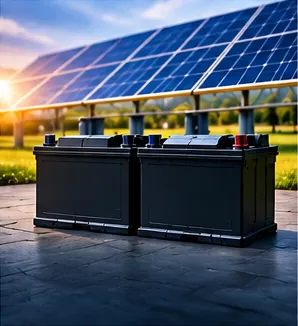
How big should a solar battery bank be?
Multiply your daily energy use (Wh) by the days of autonomy you want, then divide by the usable depth of discharge and by the inverter efficiency. Example: 3,000 Wh/day × 1 day ÷ 0.8 ÷ 0.9 ≈ 4,170 Wh of nominal storage, or about 87 Ah at 48 V.
Voltage: 12, 24 or 48 V
Higher bank voltage means lower current for the same power, thinner cables and smaller losses. Small cabins often run at 12 V; whole-house systems with large inverters are usually 48 V.
Lead-acid or LiFePO4?
Deep-cycle lead-acid (flooded, AGM, gel) is cheaper per kWh installed, but its life depends heavily on how deep you discharge it, so banks are often sized for about 50% usable. LiFePO4 is lighter and is typically rated for deeper daily cycling, but needs a compatible charger and a battery management system (BMS), and many cells must not be charged below freezing.
Always size with the depth of discharge the datasheet ties to its cycle-life figure.
Do not mix batteries of different age, chemistry or capacity in one bank.
Battery storage does not size your panels: array size depends on your location's irradiation.
Real references in our catalogue
Listed because the manufacturer’s data matches this category (type or technology). Being listed does not mean the battery suits your system — check its datasheet.
Frequently asked questions
What depth of discharge should I use for sizing?
Use the value the battery manufacturer links to its rated cycle life. Many deep-cycle lead-acid banks are planned around 50%; LiFePO4 datasheets often allow deeper cycling. Shallower cycling generally means longer life.
Can I convert Ah to kWh?
Yes: kWh = Ah × nominal voltage ÷ 1000. A 100 Ah battery at 12.8 V stores 1.28 kWh nominal. Compare batteries of different voltage in Wh, not Ah.
How many batteries go in series?
Bank voltage ÷ battery voltage. Four 12 V batteries in series make a 48 V string; strings in parallel add capacity.