
How much does it cost to charge an electric car?
Cost = energy added to the battery ÷ charging efficiency × price per kWh. Charging a 60 kWh usable pack from 20% to 80% adds 36 kWh; at 90% efficiency that is 40 kWh from the grid, or $6.00 at $0.15/kWh.
Charging time
Time ≈ energy to add ÷ effective power. The effective power is the lower of the charger rating and what the car accepts (its on-board charger on AC, its peak DC rate on DC fast chargers), times efficiency. DC charging slows down as the battery fills, so the last 20% takes longer than a linear estimate.
The 12 V auxiliary battery
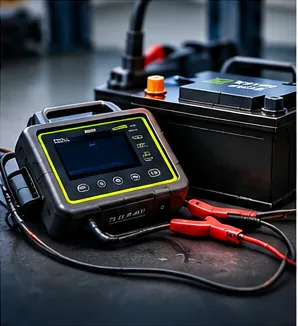
EVs and hybrids still use a low-voltage battery to boot the control electronics and close the high-voltage contactors. If it is flat, the car may not start even with a charged traction pack. Replacements must match the vehicle manufacturer's specification (technology, size, venting).
We do not publish traction-pack data for specific vehicles; enter your vehicle's usable capacity from its manufacturer.
Frequently asked questions
Why is the car's kWh lower than my meter?
Charging losses (on-board charger, cables, battery heating or cooling). The ratio between battery kWh and metered kWh is your charging efficiency.
Does a faster charger always help?
Only up to the vehicle's maximum acceptance. If the car accepts 11 kW on AC, a 22 kW charger will not charge it faster.